


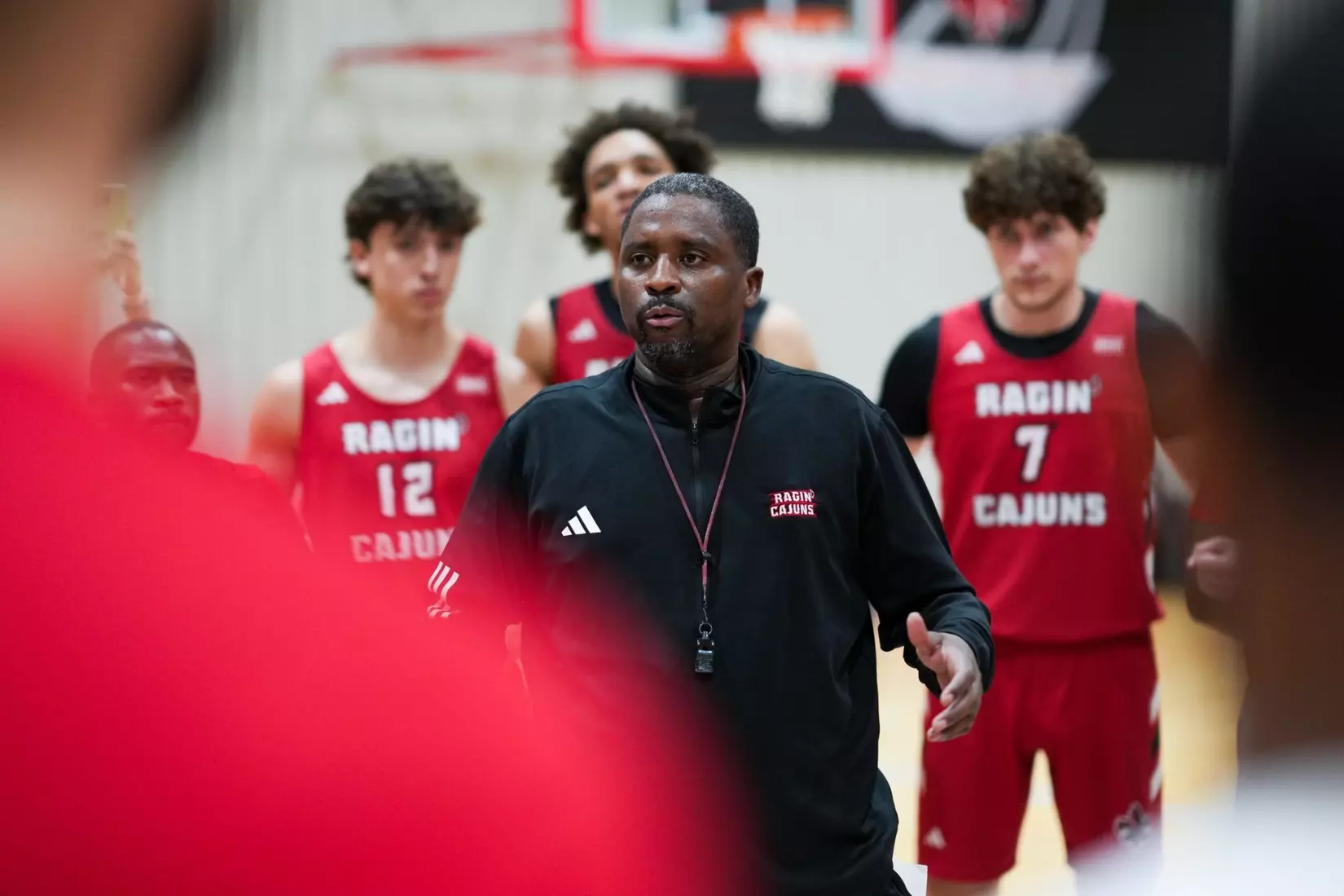
There is something unusual about the arrival of basketball season in Lafayette this year. It feels as if the 2026–27 season has crept up on us. There has been little of the usual buzz, not much noise surrounding the program, and perhaps not enough conversation about what could be a pivotal year for Louisiana Ragin’ Cajuns basketball.
Suddenly, the season is almost here.
The Ragin’ Cajuns open their second season under head coach Quannas White on November 2 against Akron at the Cajundome. There are plenty of questions worth asking. Who will replace the players who left through the transfer portal? Which newcomers can make an immediate impact? Can Louisiana finally address its lack of size inside? And what should fans reasonably expect from a program still trying to establish its identity under a new head coach?
This is a season that deserves more attention than it has received so far. Louisiana has a substantially reshaped roster, several experienced transfers, promising young talent, and a coach who knows what championship-level basketball looks like. Now comes the hard part: turning those pieces into a winning team.
The modern college basketball offseason makes roster continuity increasingly difficult to maintain. Louisiana has felt that reality entering White’s second year, with familiar contributors departing and new faces arriving to fill the gaps.
Replacing players is one thing. Replacing their production, leadership, defensive assignments, and understanding of a system is another.
The biggest challenge for Louisiana will be establishing a dependable rotation quickly enough to compete in the Sun Belt Conference. A roster full of talented newcomers does not automatically become a cohesive team. Players must learn their roles, develop trust, and understand how White wants them to play on both ends of the floor.
That is particularly important for a program seeking to regain consistency. Louisiana cannot afford to spend half the season figuring out who it is. The early schedule will provide a test of how quickly this new group can come together.
The departures through the portal also raise a broader question: Has Louisiana replaced what it lost, or has it simply added new names to the roster? The answer will become clearer once the games begin.
White and his staff have responded to the roster turnover by bringing in a mix of experienced college players and promising young talent. The transfer additions include guards Mekhi Cooper and Trent Middleton Jr., forwards Josiah Harris and Dani Pounds, and guard Deion Ware.
Cooper arrives from Lindenwood, Middleton from North Carolina A&T, Harris from Cleveland State, Pounds from Tennessee Tech, and Ware from South Plains College. Their experience at other programs gives Louisiana several players who have already been exposed to the demands of college basketball.
The key will be finding the right combinations. The most important additions may not necessarily be the players with the most impressive individual statistics. They may be the players who defend consistently, make good decisions with the ball, rebound their position, and deliver reliable minutes when games become tight.
Louisiana needs more than individual talent. It needs complementary players who can fill specific roles and give White the flexibility to adjust his lineup to different opponents.
The transfer portal has made roster construction a year-to-year challenge for programs across the country. For Louisiana, the success of this latest group will depend on how quickly its newcomers learn to play together.
One of the most glaring issues with last year's team was its lack of a true big man. Louisiana often appeared undersized in the frontcourt, creating problems that went well beyond a simple disadvantage in height.
When a team struggles to match up physically inside, the effects show up throughout the game. Defensive rebounding becomes more difficult. Opponents get second-chance opportunities. Rim protection suffers. Guards are forced to help inside, leaving perimeter shooters with more room to operate.
It is difficult to build a consistent defensive identity when you cannot reliably control the paint. And in a conference where physicality and rebounding can determine the outcome of close games, that is a problem that cannot be ignored.
The question heading into 2026–27 is whether White has done enough to fix it.
There are reasons for cautious optimism. The addition of 6-foot-8 freshman Tyshawn Duncan gives Louisiana a young forward with the size and physical tools to contribute around the basket. Transfer forward Josiah Harris also brings frontcourt experience, while Dani Pounds provides another option for the rotation.
Together, those additions give White more possibilities for constructing a lineup that can compete physically with Sun Belt opponents.
But there is an important distinction between adding frontcourt players and finding a legitimate difference-maker at center. Height alone does not solve the problem. Louisiana needs players who can establish position, finish through contact, protect the rim, rebound in traffic, and avoid foul trouble. Ideally, the Cajuns need someone who can make opposing teams think twice before attacking the basket.
Duncan's development will be worth watching, but expecting a freshman to immediately solve every frontcourt issue would be asking a lot. Harris and the other frontcourt additions must also demonstrate that they can provide the physical presence and consistency the team lacked.
This is one of the most important questions surrounding the roster because improvement inside could have a ripple effect throughout the lineup. If Louisiana rebounds better, limits second-chance points, and protects the rim, its guards can defend more aggressively on the perimeter. The Cajuns could also create more transition opportunities and have a better chance of controlling the tempo.
If those problems persist, however, it could be difficult for Louisiana to make a meaningful jump in the standings, regardless of how talented its perimeter players might be.
White does not necessarily need a dominant seven-footer to compete in the Sun Belt. He does need a reliable interior presence. Until the Cajuns prove they can hold their own in the paint, the question of whether they have enough size will remain one of the defining storylines of the season.
One of the more encouraging elements of Louisiana's incoming talent is the potential of Duncan, a four-star prospect from Alexandria Senior High.
At 6-foot-8, Duncan brings size, rebounding potential, and the physical tools to develop into an important frontcourt contributor. His arrival gives Louisiana a young player who could help address some of the team's needs around the basket.
Point guard Isaiah Wilks is another intriguing addition. The Oklahoma City native helped Millwood High School win a state championship and arrives with a reputation for scoring, ball pressure, and playmaking.
At 5-foot-9, Wilks will have to prove that he can handle the physical demands of college basketball. Still, his competitiveness and ability to create opportunities could be valuable for a team looking for consistent guard play.
The recruiting class also included 6-foot-7 wing Zayson Salanoa, an accomplished Texas high school player known for his outside shooting.
Freshmen rarely deliver consistently from day one, and it would be unrealistic to expect every young player to make an immediate impact. But if Duncan can contribute inside and Wilks can provide quality minutes at point guard, Louisiana could benefit from their energy and versatility sooner rather than later.
Their development will also help determine the team's longer-term outlook. White needs to build a roster that can compete now while developing young players who can become important contributors in future seasons.
Perhaps returning player carries a more intriguing storyline than preseason All-SBC player Jamyron Keller.
Keller made only two appearances last season before an injury cut short his campaign. In those two games, he averaged 17 points, including a 21-point performance against Ball State and 13 points against Southeastern Louisiana.
That is an extremely small sample, and it would be unfair to assume those numbers will automatically carry over across a full season. Nevertheless, they provide a glimpse of the scoring potential Louisiana could have if Keller returns healthy and establishes himself as a dependable offensive option.
His importance goes beyond points. A team with so many new players needs someone capable of creating offense when possessions break down, taking responsibility late in games, and providing a familiar presence within the rotation.
If Keller can stay healthy, he could become one of the most important players on the roster. His recovery and consistency will be among the developments worth following as the season unfolds.
White arrived in Lafayette with an impressive résumé. His time at Houston under Kelvin Sampson exposed him to a demanding defensive culture, disciplined preparation, and the daily standards required to compete at a high level.
That background is encouraging. But success as an assistant at a nationally prominent program does not automatically translate into immediate success as a head coach.
Louisiana's first season under White was difficult, leaving the program with plenty of room for improvement and making the second season particularly important.
Year two should offer a clearer picture of White's identity as a head coach. Fans should expect to see progress in several areas.
First, the team needs a recognizable defensive identity. White's Houston background suggests that effort, toughness, communication, and discipline should be priorities. Louisiana does not necessarily need to lead the nation in defense, but it should be difficult to play against and capable of getting stops when games are on the line.
Second, the offense must become more dependable. That means limiting careless turnovers, generating quality shots, making better decisions in late-game situations, and developing a reliable approach when opponents take away the first option.
Third, White must show that he can build a cohesive roster despite the realities of the transfer portal. Recruiting talent is important, but identifying complementary players and creating continuity are equally essential.
Finally, the Cajuns need to be more competitive against quality opponents. Progress should be measured not only by wins and losses, but also by how the team handles adversity, closes games, and performs against stronger programs.
The expectation should not be an immediate transformation into a championship contender. It should be a visible step forward.
For White, that means demonstrating that the team has a clear identity, that players understand their roles, and that the Cajuns are becoming more consistent in the areas that decide close games.
Louisiana will not have to wait long to find out where it stands.
The season opens November 2 against Akron, a program that reached the 2026 NCAA Tournament after winning the Mid-American Conference tournament. Other early challenges include a November 14 road game at UNC Wilmington, a trip to California for the Palm Springs Holiday Classic, and a November 28 home matchup against McNeese.
The Cajuns will also visit Tulane on December 5 and LSU on December 22, giving Louisiana fans a pair of in-state matchups to circle on the calendar.
Those games will reveal plenty about the team's readiness. Can the newcomers handle the speed and physicality of experienced opponents? Will the offense generate enough consistent scoring? Can Louisiana defend without putting itself in foul trouble? And will White's team respond when it faces adversity?
The Sun Belt schedule will ultimately determine the Cajuns' conference standing, but the nonconference slate offers an early measuring stick.
Louisiana was picked sixth in the Sun Belt's preseason poll, placing the team in the middle of the conference conversation rather than among the favorites. That projection provides a reasonable starting point for a roster undergoing significant change, but it also gives White an opportunity to outperform expectations.
A strong opening stretch could help generate the excitement that has been missing from the offseason. A difficult start, on the other hand, would put immediate pressure on a team still trying to find its footing.
The most reasonable expectation is improvement, not miracles.
Louisiana has added experience through the transfer portal, recruited promising young players, and has a potentially important scoring option in Keller if he can remain healthy. Those are reasons for optimism. Yet the roster's turnover, the challenge of integrating so many newcomers, and the uncertainty surrounding the frontcourt make it premature to predict a dramatic breakthrough.
A competitive team capable of finishing in the upper half of the Sun Belt would represent meaningful progress. A strong conference finish would be an even more encouraging sign. Reaching that level will depend on health, defensive consistency, guard play, rebounding, and the ability to win close games.
The clearest measure of progress may be inside. If Louisiana rebounds better, protects the rim, and stops allowing opponents to control the paint, that could be just as meaningful as any improvement in the win-loss record.
The frontcourt issue deserves particular attention because it could determine the ceiling of this team. Louisiana may have enough talent on the perimeter to be competitive, but a lack of interior size can undermine an otherwise solid roster. White needs to show that his new personnel can address that weakness.
Just as important, fans should look for evidence that White is building something sustainable. A program cannot rebuild its identity every offseason and expect long-term success. The coach must establish standards that survive roster changes, develop players, and create a style of basketball that becomes recognizable.
The next step is proving that those standards can produce results.
Perhaps the strangest part of this season is how quietly it has approached. November basketball is nearly upon us, yet there has not been the kind of anticipation that makes a new season feel like an event.
That can change quickly. One impressive opening performance, a promising stretch against quality opponents, or an unexpected conference win can get people talking again.
Louisiana basketball has enough interesting pieces to make this season worth following. Keller's return, Duncan's arrival, the contributions of the transfer class, the development of the frontcourt, and White's growth as a head coach all provide storylines worth watching.
The questions are real, and so are the opportunities.
White is entering the season with a roster that looks different, a program that needs momentum, and a fan base looking for signs that Louisiana basketball is moving in the right direction. He does not need to solve every problem in November, but he does need to show that the foundation is getting stronger.
The season may have crept up on us, but the next few months should tell us a great deal about where the Ragin’ Cajuns are headed.
For Louisiana basketball, year two is about turning potential into progress… and giving fans a reason to believe that better days are ahead.
C’est Tout. Allons Q!
Get breaking news and curated stories delivered to your inbox every day. Be the first to know what’s happening around Louisiana athletics!


Lorem ipsum dolor sit amet, consectetur adipiscing elit. Suspendisse varius enim in eros elementum tristique. Duis cursus, mi quis viverra ornare, eros dolor interdum nulla, ut commodo diam libero vitae erat. Aenean faucibus nibh et justo cursus id rutrum lorem imperdiet. Nunc ut sem vitae risus tristique posuere. uis cursus, mi quis viverra ornare, eros dolor interdum nulla, ut commodo diam libero vitae erat. Aenean faucibus nibh et justo cursus id rutrum lorem imperdiet. Nunc ut sem vitae risus tristique posuere.
Delete